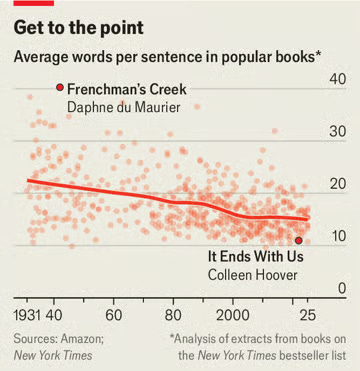
I once knew someone, in fashion, who had a simple rule: one in, one out. Meaning: each time she brought home a new outfit or a new pair of shoes, she had to donate or give away something to make room in her closet.
I need to start applying this philosophy to open tabs in my Internet browser. This is truly unwieldy. (You don’t want to know what my desktop screen looks like.)
Even though I haven’t been sending out these Multitudinous Musings as much as I used to - as much as I want to be - as much as I should be (but “should be” according to whom?) - that isn’t to say that I haven’t been reading. It is to say that I haven’t figured out how or why to continue sharing what I have been reading, or if what I am reading is still relevant or interesting - at this time in the world and history, in this place, or to others, or to you, reading this.
Or even if you are reading. I know that I am generally, always, bemoaning the fact that I read much less than I used to. And I spend much less time thinking than I used to. (on Not Reading Enough in 2025, on Reading More in 2024)
To that point, I want to share only one - long - piece today.
HIGHLY RECOMMENDED READING - Top of Mind
The Dawn of the Post-Literate Society, by James Marriott
(published on his substack Cultural Capital)

This piece is a striking and comprehensive meditation not only on literacy, but on critical thinking and comprehension in society, where we’ve been and where we are going. The overview:
The age of print
The counter revolution
An intellectual tragedy
World without mind
The end of creativity
The death of democracy
Into the moronic inferno
I could quote the whole thing. Take, for example:
Never before has there been a technology like the smartphone. Where previous entertainment technologies like cinema or television were intended to capture their audience’s attention for a period, the smartphone demands your entire life. Phones are designed to be hyper-addictive, hooking users on a diet of pointless notifications, inane short-form videos and social media rage bait.
The average person now spends seven hours a day staring at a screen. For Gen Z the figure is nine hours. A recent article in The Times found that on average modern students are destined to spend 25 years of their waking lives scrolling on screens.
If the reading revolution represented the greatest transfer of knowledge to ordinary men and women in history, the screen revolution represents the greatest theft of knowledge from ordinary people in history.
This piece beautifully weaves (depressing) statistics, research, quotes from other articles, and observations. Further on, Marriott writes,
The greatest novels and poems enrich our sense of the human experience by imaginatively putting us inside other minds and taking us to other times and other places. By reading non-fiction — science, history, philosophy, travel writing — we become deeply acquainted with our place in the extraordinary and complicated world we are privileged to inhabit.
Smartphones are robbing of us of these consolations.
The epidemic of anxiety, depression and purposeless afflicting young people in the twenty-first century is often linked to the isolation and negative social comparison fostered by smartphones.
It is also a direct product of the pointlessness, fragmentation and triviality of the culture of the screen which is wholly unequipped to speak to the deep human needs for curiosity, narrative, deep attention and artistic fulfilment.
Marriott points out that music and film are becoming less complex, and even repetitive (think: franchises and nostalgic covers), and that “Studies suggest that the number of “disruptive” and “transformative” inventions is declining. More money is spent on scientific research than ever in history but the rate of progress “is barely keeping pace with the past”.”
I’ll speak for myself here: I know that I am addicted to the Internet, my phone and my laptop, when I feel that anxiety for the first few hours when I consciously choose to disconnect all my electronics and pack them away for an Internet-free long-weekend camping trip. But I am also always craving that silence and disconnection; sometimes (often) wishing that my smartphone will die, and I will be completely unreachable.
What are you reading? Online, or in print?
If you read one thing this week, I hope you read this piece.
“Our culture is being transformed into a smartphone wasteland.” - James Marriott